Urbanism On Tap Talks Up Tampa Bay’s Future
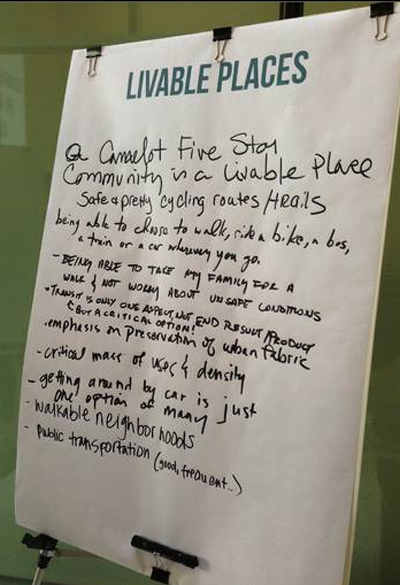
Urbanism on Tap starts by soliciting participants' visions for Tampa. Among concerns at the first open mic night? Transit, mobility, green spaces, bicycling safety, connectivity, neighbhorhoods and other liveability issues.
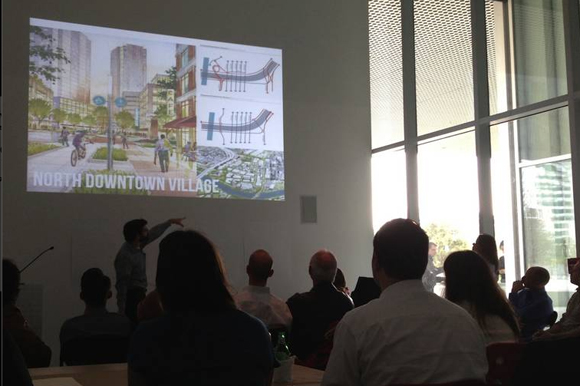
The regional chapter of the Congress for the New Urbanism (CNU Tampa Bay) and The Urban Charrette have launched Urbanism on Tap, a series of community events in which citizens can engage in constructive conversations about current issues facing the Tampa Bay metropolitan region. Presented in an open mic format, the events will be a bi-monthly source of free-flowing discussion about how Tampa can continue to grow as a progressive, competitive and vibrant city. Presented in a series of three events at a time, the goal is provide a forum for diverse members of the community to work together to address issues in our city.
The first series of events called Rival Cities is focused on understanding Tampa’s vision for the future and how that compares to other vibrant communities throughout the country. The first event of the series, held March 12 at the Tampa Museum of Art, outlined the vision recently established by Invision Tampa, a downtown master plan completed for the City of Tampa. Then the mic was turned over to the audience, which included city commissioners, city officials, business owners, designers and interested citizens. They discussed questions like: What do you think about this vision? What’s missing? And, how do we start to make it a reality?
Participants had a lot to say, but’s let’s step back and consider why is it important for a city to talk about vision. Economies now span across regions, countries and the globe. Cities play a different role today: Instead of just providing for its citizens, cities must attract new professionals, industries and services that allow it to be on the world economy stage. If a city can’t compete with similar cities, it will lose out on growth and subsequently a larger tax base. Less money in a city means less of an ability to maintain its infrastructure and provide the daily necessities of living. Every city wants to grow, and grow sustainably. Uncontrollable growth can lead to negative effects that plague cities for decades; example in point, the growing suburbs of the last half of century that have left cities and counties struggling financially. So if a city has a vision that will attract the right type of investment, that will lead to the right type of growth that will contribute to the city’s livability and health the city will be a player in the world economy.
So what is Tampa’s vision? According to Invision Tampa, “Center City Tampa will be a community of livable places, connected people, and collaborative progress that embraces and celebrates its river and waterfront.” The plan states that it “should help address and make downtown Tampa the people’s downtown for the next 20 years, responding to the ideas and needs of the community.” In discussing this vision, The Urbanism on Tap team asked event participants to define what these terms mean to them.
Defining The Terms
The Invision Tampa vision statement carries a familiar message to residents of Tampa. The Tampa Downtown Partnership‘s Vision and Action Plan and the American Institute of Architects’ (AIA) Sustainable Design Assessment Team: Connecting Tampa Plan established similar visions in 2005 and 2008. Both call for more walkable neighborhoods with local amenities built around a vibrant downtown core with active public places along the riverfront.
The Urbanism on Tap discussion of this vision focused on a strong economy, strong neighborhoods, transportation, urban places/urban design, livability and citizen participation. Visit CNU Tampa Bay’s website to continue the Urbanism on Tap discussion and to see more detailed participant comments on Tampa’s vision. A few suggestions include Tampa’s need for a primary target industry, neighborhoods with communal space that can be accessed by walking, cycling and public transportation, the best technology in efficient mass transit, safe and secure public spaces, and individual responsibility to demand action.
The next installment of the Rival Cities series will examine other cities that are Tampa’s direct competition on the global economy stage. Invision Tampa mentions San Diego and Charlotte as cities to emulate for their expertise in economic development and transportation livability, respectively. While Charlotte is no doubt a competitor, we can look a little closer to home: Orlando is perhaps our largest investment competitor with similar industries, climate, population and geography. Stay tuned to CNU Tampa Bay and The Urban Charrette for the announcement of the date of the next Urbanism on Tap event, as well as an announcement of which cities we consider Tampa’s rival cities.
Spoiler Alert
The first Urbanism on Tap event established that the lack of mention of Tampa’s streetcar in the Invision Tampa plan is a missed opportunity for achieving a more efficient mass transit system, which was identified in the Invision Tampa public involvement process as the most important thing the city must do. As one of the oldest streetcar systems in the U.S. revival of streetcars, Tampa’s system has suffered a lack of funding and political support that systems like Portland (just one year older) have enjoyed. Since their inceptions in 2002 and 2001, respectively, Tampa has remained at 2.7 miles, while Portland has grown to over 9 miles.
While the Invision Tampa plan mentioned cross river transit and an urban form that could support it, it didn’t set forth a vision for a mass transit system that would bring competitive investment to Tampa, as well as serve the desires and needs of the community. Some more food for thought? Rival cities like San Diego, Charlotte and Orlando have invested in premium transit — San Diego in a streetcar, light rail and commuter rail; Charlotte in light rail and a streetcar; and Orlando in commuter rail. Transit talk and discussion around Tampa’s streetcar will certainly be a topic of conversation at the next installment of Urbanism on Tap. Stay tuned.
Erin Chantry is an urban designer and executive committee member of CNU Tampa Bay, the regional chapter of The Congress for the New Urbanism. She is also the author of the urban design blog, At the Helm of the Public Realm. With a BA in architecture, an MA in urban design and an MS in urban planning, she has expert knowledge in New Urbanism, LEED for Neighborhood Development, and how sustainable city planning and urban design can be used as a catalyst for redevelopment. Comments? Contact 83 Degrees.
Related Articles
83 Degrees announces changing of the guard
Andrea Daly succeeds Founder and longtime Publisher Diane Egner, who will stay involved with 83 Degrees.
ULI Tampa Bay Trends: Insider insights on state of real estate
ULI Tampa Bay Trends Conference is the place for up-to-date info on Bay Area’s real estate industry.
Photos: Craft’s History & Cigar Cruise celebrates Ybor’s 140th anniversary
Photos from Craft’s History & Cigar Cruise celebrating Ybor City’s 140th anniversary.